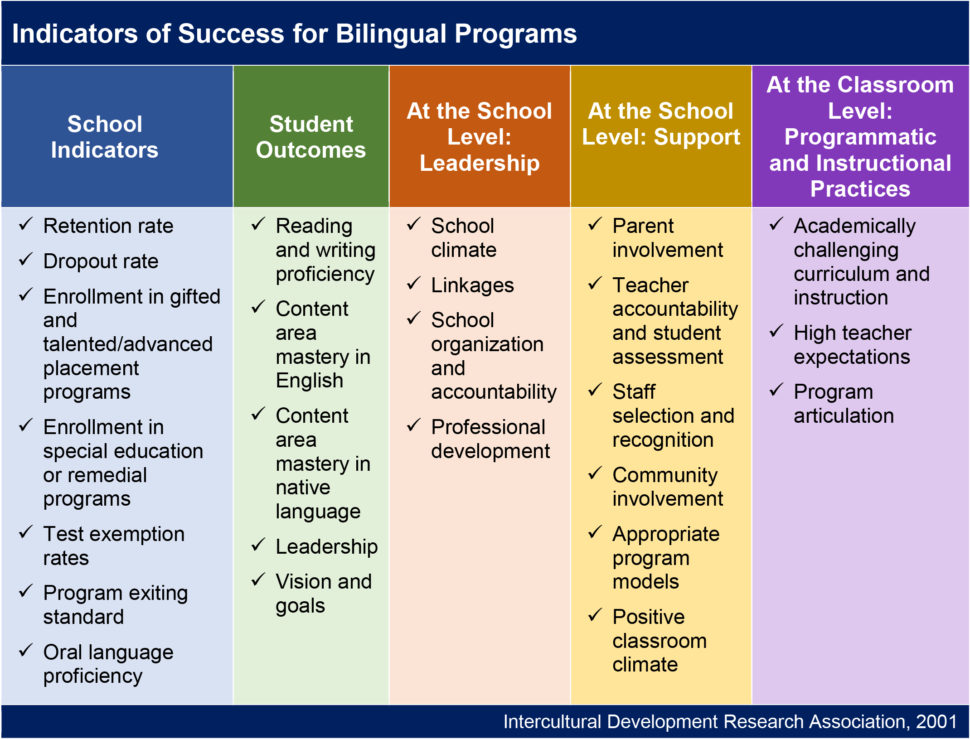
Research by the Intercultural Development Research Association (IDRA) has identified the 25 common characteristics of successful schools that contribute to high academic performance of students learning English. To help others identify successful programs or raise the bar with their own bilingual education programs IDRA has produced Good Schools and Classrooms for Children Learning English. This guide is a rubric, designed for people in schools and communities to evaluate five dimensions that are necessary for success:
- school indicators,
- student outcomes,
- leadership,
- support, and
- programmatic and instructional practices.
These dimensions were identified by IDRA’s research study, “Successful Bilingual Education Programs: Development and Dissemination of Criteria to Identify Promising/Exemplary Practices in Bilingual Education at the National Level,” which was funded by the U.S. Department of Education. IDRA studied 10 bilingual education programs across the country with high academic success of their students. Researching these programs, IDRA identified the common characteristics and criteria that are contributing to the success of students served by bilingual education programs.
There are an estimated 4.4 million English-language learners in U.S. schools. Research has shown that bilingual education, when well implemented, is the most effective way to teach English to speakers of other languages while also teaching core subjects like math, reading and social studies. This research study and the corresponding publication, Good Schools and Classrooms for Children Learning English, highlight some of the practices in schools that enable students to grow academically and socially in their native language as well as English.
Classnotes Podcast
Good Schools for Children Learning English – Podcast Episode 14
Articles about “Good School and Classrooms for Children Learning English”
Bilingual Research Journal
“Successful Bilingual Education Programs: Development and Dissemination of Criteria to Identify Promising and Exemplary Practices in Bilingual Education at the National Level”
by M. Robledo Montecel and J.D. Cortez. (Spring 2002) Vol. 26, No. 1
IDRA Newsletter
See the whole six-part series in PDF or in html below.
“Successful Bilingual Education Programs: Criteria for Exemplary Practices in Bilingual Education”
Study introduction and methodology by M. Robledo Montecel and J.D. Cortez. (August 2001)
“Successful Bilingual Education Programs: 10 Schools Serve as Models”
Overview of participating schools in the study. Includes profile of Heritage Elementary School, Woodburn, Oregon.
by M. Robledo Montecel and J.D. Cortez. IDRA Newsletter (September 2001)
“Successful Bilingual Education Programs: Student Assessment and Outcomes”
Overview of participating schools’ systems of student assessment. Includes profile of James Bowie Elementary School, Pharr, Texas.
by M. Robledo Montecel, J.D. Cortez and A. Cortez. IDRA Newsletter (October 2001)
“Successful Bilingual Education Programs: Indicators of Success at the School Level”
Part I of major findings. Includes profile of Paul Bell Middle School, Miami-Dade County, Florida.
by M. Robledo Montecel and J.D. Cortez. IDRA Newsletter (November-December 2001)
“Successful Bilingual Education Programs: Indicators of Success at the School Level Part II”
Part II of major findings. Includes profile of St. Mary’s Public School, Mount Angel, Oregon.
by M. Robledo Montecel and J.D. Cortez. IDRA Newsletter (January 2002)
“Successful Bilingual Education Programs: Indicators of Success at the School Level Part III”
Part III of major findings and summary. Includes profile of River Glen Elementary School, San José, California.
by M. Robledo Montecel and J.D. Cortez. IDRA Newsletter (February 2002)