Texas schools are losing 11 students per hour
Nationally, our schools are losing one of every four students.
This lack of school holding power affects every one of us.
With the magnitude of this loss, what is needed is a seismic shift from dropout prevention to graduation for all. And all must mean all.
“Since this problem is systemic, the solutions must address schools as systems.”
– Dr. María “Cuca” Robledo Montecel, IDRA executive director
Communities and their neighborhood public schools can turn the tide. Together we can and must guarantee that every child graduates from high school!
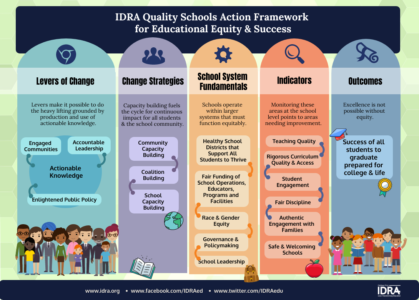
IDRA’s Quality School Action Framework guides communities and schools in identifying weak areas and strengthening public schools’ capacities to graduate and prepare all students for success. IDRA’s book, Courage to Connect: A Quality Schools Action Framework™ shows how communities and schools can work together to be successful with all of their students. The book’s web page provides a table of contents, excerpt, related podcasts and other resources.
Research
 Texas High Schools Lost 1 in 5 Students Last Year – IDRA attrition study
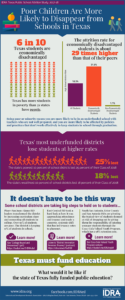
Poor Children Are More Likely to Disappear from Schools in Texas
Individual Graduation Committees
Testimony: TLEC Urges Texas House to Permanently Allow the Use of Individual Graduation Committees
Policy Brief: Don’t Block Graduation Because of a Test
Infographic: Use of Individual Graduation Committees Unlocks Diplomas for 14,422 Qualified Students in Texas

Effective Dropout Prevention – IDRA Valued Youth Partnership
All children are valuable; none is expendable. But the fact is U.S. high schools lose more than one-third of their students before graduation, and the cumulative impact of this attrition affects every person. But, schools can increase their holding power by transforming how they recognize students’ inherent value, their contributions, and their potential significance to their communities and society, as a whole. The Valued Youth Partnership is a research-based, internationally-recognized dropout prevention program that is keeping more than 98 percent of participating students in school, young people who were previously at risk of dropping out. This story gives an overview of the Valued Youth Partnership, which has worked dramatically everywhere it has been.
 College Bound and Determined – School District Proves that a School District Can Assure that All Students are College Bound

Today, IDRA is releasing a new report, College Bound and Determined, showing how the Pharr-San Juan Alamo school district in south Texas transformed itself from low achievement and low expectations to planning for all students to graduate from high school and college. In PSJA, transformation went beyond changing sobering graduation rates or even getting graduates into college. This school district is changing how we think about college readiness.
Can’t Wait to Celebrate 100% Graduation in Texas
In a Statement on TEA’s latest dropout study, IDRA President Dr. María “Cuca” Robledo Montecel stated, “Schools are not underperforming because children in them are poor or black or brown. Rather, it is poor policies, poor practices and inadequate investments that hold our children back… We at IDRA will not celebrate until all students enrolled in Texas graduate from high school with a college-ready high school diploma in four years.”
Free eBook on Types of Dropout Data
When IDRA first examined the dropout issue in Texas, there was no dropout data or standard method for counting dropouts. Over time, researchers have developed several methodologies in order to see the problem from different angles. We know that it’s easier to ignore a problem and discount students when they aren’t counted in the first place, which is why IDRA has kept the dropout issue at the forefront with its annual studies, related reports and congressional testimony. Though each method described in this eBook has different meaning and calculation methods, each provides unique information that is important for assessing schools’ quality of education and school holding power.
IDRA Policy Issues for Texas
IDRA’s stands regarding student tracking and quality curriculum for all students are:
- No student or any group of students should be tracked into low-level courses nor into different diploma routes or graduation plans.
- Schools should provide a high-quality curriculum that prepares all students to enroll in and complete college, supplemented by optional courses that prepare them to enter the workforce after graduation.
- The same high-quality curriculum should be available to all students in all schools, including those placed in alternative education settings.
IDRA’s stands regarding teaching quality are:
- Texas must ensure that all students have access to quality teaching that is equitable within and across school districts.
- Teacher preparation programs should be updated to prepare educators to serve an increasingly diverse student population.
- Teachers should have the appropriate preparation, training and support to manage classrooms such that students are not unnecessarily or disproportionately separated from learning on their campus by suspensions, expulsions and removals to disciplinary alternative education programs.